A betting system that focuses on the Both Teams To Score market and predominantly the “No” result. This is a system with 3 years worth of verified data against the bookmakers and one that has won many awards in its time. A high volume strategy with over 250 selections expected per month and a rather impressive 9% ROI. So what’s not to like? The issue is that all current reviews are against the bookmakers and you won’t find any taking on the exchanges. With such a strong long term ROI, surely this strategy has legs against the exchanges? In this article we put Lulas BTTS to the test against Betfair alone. We expected a drop in ROI but there should be enough headroom for a positive trial.
The Lulas BTTS Service
Lulas BTTS is one of several Tipstrr services we’ve reviewed on BET, and it’s fair to say we’re big admirers of the platform and the profitable tipping services it hosts.
For those unfamiliar with Tipstrr, it’s a marketplace where anyone can create and run their own subscription-based tipping service across a wide range of sports and betting markets. Crucially, the platform independently verifies all results, ensuring that quoted odds were genuinely available at the time of posting. This means you can trust that each service’s performance statistics are accurate and achievable in real-world conditions.
The only problem with Tipstrr for us is that they are bookmaker focused and do not cover the exchanges. That is where we come in. Lulas BTTS is one of the few football tipping services on the platform to provide selections for the Both Teams to Score market.
Tipstrr also makes it easy to evaluate a service at a glance, presenting key performance metrics in a single dashboard view. The image below shows Lulas BTTS’ historical performance based on £10 level stakes.
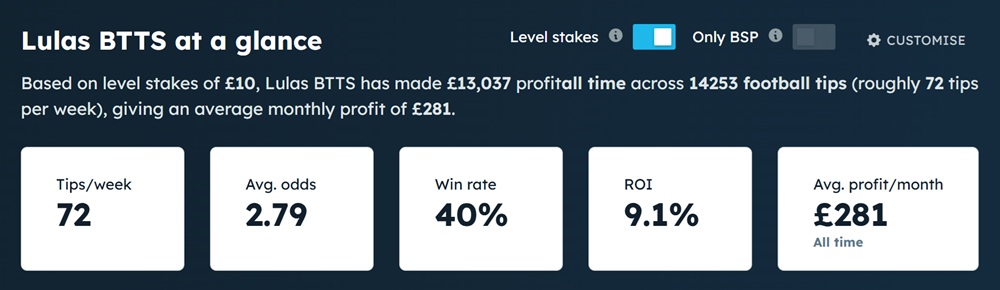
As the figures show, this is a high-volume service, averaging around 72 selections per week. Very few of these are odds-on, with subscribers typically seeing average odds of 2.79. Even more impressive is the total P&L of over £13,037 profit to bookmaker prices, all independently verified by Tipstrr & achieved within just three years.
If we take a deeper dive, the Stats tab provides a comprehensive breakdown, including monthly performance charts, results by market type, bookmaker comparisons, posting times, etc etc.
In general, Lulas BTTS tips are released at least six hours before kick-off, and they usually land in subscribers’ inboxes early morning UK time, giving plenty of opportunity to get involved.
Getting Started…
Using Lulas BTTS works exactly the same way as any other Tipstrr service. Start by creating a Tipstrr account & this single account gives you access to any services you choose to subscribe to. Then, simply click the brown “Join” button on the Lulas BTTS page and follow the on-screen instructions.
Once subscribed, you’ll receive selections in two ways:
- By email — Tipstrr notifies you each time Lulas BTTS posts a new tip.
- Via your dashboard — log into your account and select “Account Dashboard” from the left-hand menu to view all active tips across every service you follow.
You can also visit the Lulas BTTS page at any time to review updated statistics and performance charts.
Tipstrr is deliberately designed to be simple and straightforward. There is no direct communication with individual tipsters. The platform’s role is to supply the selections, present historical data, and provide independent verification of past results.
Service Pricing & Membership Packages
Lula’s BTTS is available at a flat rate of £29 per month. Unlike many Tipstrr services, there’s no introductory discount & given its three years of strong, verified results, it’s easy to see why. There are also no tiered memberships, it’s a simple choice, you’re either in, or you’re not.
At first glance, £29 per month represents excellent value. Subscribers receive more than 70 selections per week, supported by a verified ROI that outperforms most other football services on the platform. Comparable services with similar levels of consistency and profitability are often priced closer to £100 per month.
If the system can deliver results on the exchanges that come anywhere near its bookmaker-verified performance, only modest staking would be required to comfortably cover the subscription cost.
Exchange Trial
The primary challenge we anticipate with Lula’s BTTS on the exchanges is market liquidity. The service focuses on the Both Teams to Score market which, on the exchanges, isn’t among the most active. Combine that with the high volume of selections from lower-tier and lesser-known leagues, and liquidity could become a genuine issue during the trial.
Our pre-trial checks indicate that the best time to place bets on the exchange is within the final minute before kick-off, allowing the market as much time as possible to mature. The results we publish will therefore be based on prices taken at that point. After the trial, we’ll also compare performance with odds available at the moment tips are released.
With average odds of 2.79 (based on Lula’s historical stats), a sensible betting bank needs to withstand a worst-case drawdown of around 35 points across 1,000 bets. Fortunately, the subscription price is modest, and if performance holds anywhere near the historical figures, stakes don’t need to be large to comfortably cover costs. For this trial, we’re recommending a £1000 bank and staking 1% (£10) per selection. This will comfortably withstand two worst-case drawdowns.
We’ll be using the Betfair Exchange only. Given the liquidity concerns, using lesser exchanges risks taking poor-value prices. Each Lula’s BTTS tip includes both an Advised Price (used for Tipstrr’s verified stats) and a Minimum Price. While matching the advised odds may prove difficult on the exchange, the minimum price should be easily achieved. For this review, we will only place bets where the available odds on Betfair meet or exceed the Minimum Price.
Final Review Results
After passing the 1,000-bet mark, we have obtained a substantial sample of real exchange data to analyse. So, how did the service perform?
One of the key questions we wanted to answer from the outset was when to place the bets: immediately upon receiving the selections or closer to kick-off. The Both Teams To Score market is relatively niche on the exchanges, and this is compounded by Lulas BTTS covering a number of smaller and lesser-known leagues where liquidity can be limited. To investigate this, we recorded results using both entry points. The conclusion is clear: waiting until five minutes before kick-off produced the better results, delivering a 1.02 percentage point improvement in ROI compared with betting when the selections were received. With the markets more fully formed and liquidity generally stronger closer to kick-off, this appears to be the more effective approach.
As a result, all results and analysis presented from this point onwards will be based on bets placed five minutes before kick-off.
Consistent Tip Delivery
Tip delivery and consistency were significant positives for the Lulas BTTS service. Selections were issued once per day and, importantly, were always delivered several hours before the first scheduled match, giving members plenty of time to review and place their bets. Our exchange trial ran for eight months, from December through to July, and there were only around three days throughout the entire review period when no selections were provided.
We were able to place an average of approximately six bets per day on Betfair, representing around 60% of all selections received. The shortfall was primarily due to Betfair not offering markets on some of the leagues covered by the service. Expanding the trial to additional exchanges such as Betdaq, Matchbook or Smarkets could potentially increase the number of available selections, although liquidity could become an issue given the specialist nature of some of the leagues.
Overall, however, Lulas BTTS delivered a consistently high volume of selections with excellent advance notice, providing plenty of opportunities to participate on the exchanges throughout the trial.
Service Profitability
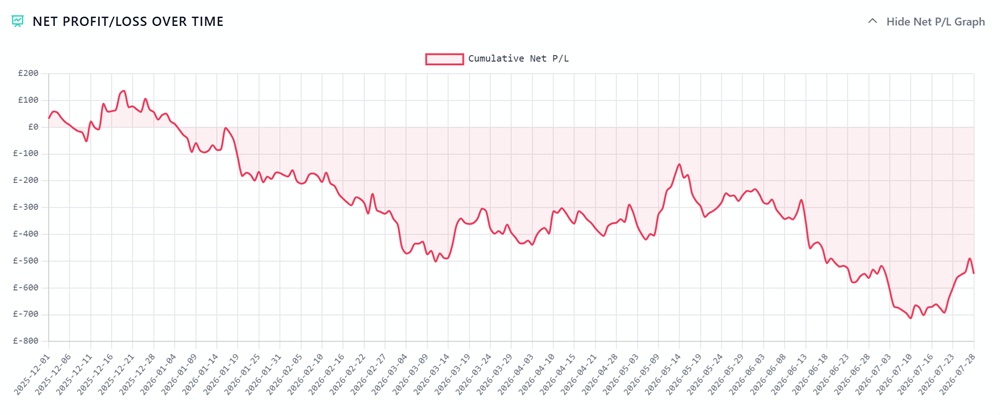
Across 1,100 Lulas BTTS selections placed on the exchanges five minutes before kick-off, we recorded a net loss of -£547.62 after Betfair commission. This represents an ROI of -4.98%, reducing our initial £1,000 betting bank to £452.38. The contrast with the official service results is significant. Over the same period, Lulas BTTS recorded a +£718.13 profit, with all results verified by Tipstrr. The images below provide a detailed breakdown of our Lulas BTTS exchange trial results.

The difference between the two sets of results is substantial. In total, there was a £1,265.75 delta between our exchange performance and the official results reported by the service. Given that Tipstrr independently verifies the results of its services, we are confident that the official bookmaker figures are accurate. So, what explains such a significant difference?
Our investigation identified three key factors…
Early Value Is Critical
Firstly, Lulas BTTS is designed to identify early bookmaker mispricing, allowing subscribers to take advantage of inflated odds before the market has had time to adjust. This presents a fundamental problem when moving the strategy to the exchanges. The exchanges do not generally offer early pricing on the Both Teams To Score market, meaning that when Lula’s selections are first released, many of the corresponding exchange markets have yet to properly form. Attempting to back these selections at this stage can therefore mean accepting heavily negative-value prices. By the time the exchange markets become sufficiently liquid to use, the bookmakers have often already shortened their prices to reflect the underlying information. The opportunity identified by the Lula’s model has therefore largely disappeared.
Interestingly, this isn’t immediately obvious from the average odds. Our recorded exchange average was 2.78, almost identical to the service’s 2.79. The issue is therefore not simply that we were taking significantly lower prices—it is more about when those prices became available and whether the original value still existed.
Exchange Market Coverage
The second factor is the leagues covered by the service. Tipstrr’s Lulas BTTS statistics page provides a breakdown of the leagues that have contributed most to its historical profits. We found that three of the four most profitable leagues for the service are simply not available on Betfair. This is potentially significant. It suggests that some of the strongest edges identified by the Lula’s model come from more obscure leagues, where bookmaker pricing may be less efficient. Unfortunately, these are precisely the markets we were unable to access during our exchange trial. As a result, a significant proportion of the service’s historical profitability could not be replicated on Betfair.
Exchange Commission
Finally, there is the additional cost of betting on the exchange. Throughout the trial, we paid £134.83 in Betfair commission. While this represents only a relatively small proportion of the £11,000 we staked, it still accounts for approximately 10.7% of the overall £1,265.75 difference between our exchange results and the official service results.
Our trial does not dispute the historical performance of Lula’s BTTS against bookmakers. The official results are independently verified by Tipstrr, and our analysis provides no reason to question those figures. Unfortunately however, the same strategy does not translate successfully to the Betfair Exchange under the same conditions.
The combination of early bookmaker value, limited exchange coverage of the leagues producing the strongest historical returns, and exchange commission creates a very different betting environment. Whilst we fully believe that Lula’s BTTS beats the bookmakers and the official results are accurate it does not beat the exchanges under the same conditions.
Profitable Enhancements
Despite the overall negative return, there are several potential approaches that could move Lulas BTTS into profitable territory on the exchanges. Interestingly, the BTTS “Yes” selections generated a +6.33-point profit, although the sample size is far too small to draw any firm conclusions. Only 22 of the 1,100 selections during the trial were BTTS “Yes”.
The first potentially profitable approach is to filter the BTTS “No” selections to those priced between 2.5 and 3.1. This reduces the number of bets placed during the review period to 592, which remains a substantial sample, while producing a +21.22-point profit. At our £10 level stakes, this equates to a £212.20 profit and a positive 3.59% ROI. Applying the Whitaker staking plan (ELS5/1000) improves the return slightly further, increasing profitability by around 4%. The image below illustrates the resulting bank growth throughout the betting period.
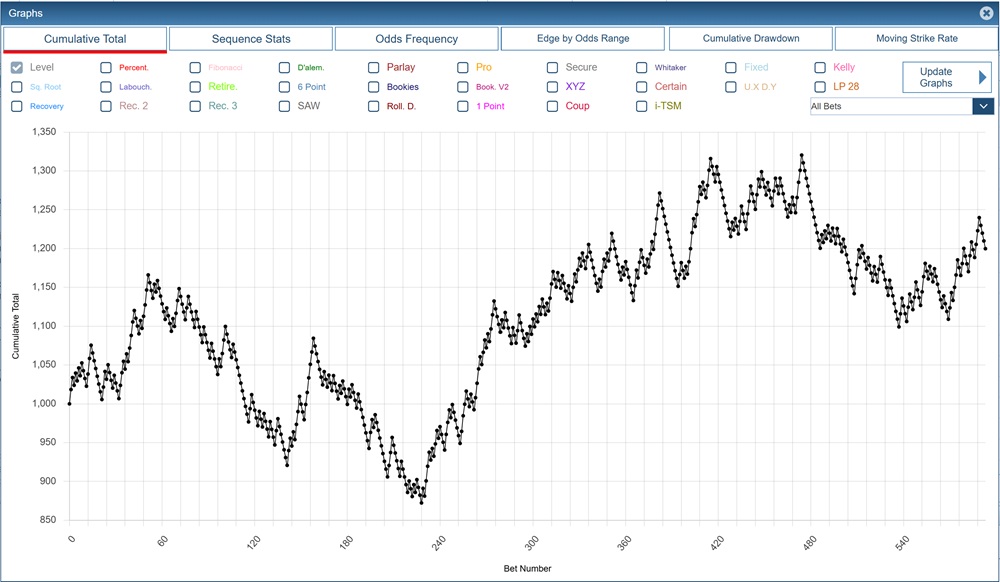
The application of the odds filter, combined with the relatively consistent prices across the qualifying selections, makes this strategy particularly well suited to combining bets into multiples. Using Rolling Doubles on the exchange where the profit from the first bet is carried forward and staked on the second allows the expected value to compound and more than doubles the overall profit achieved during the review period.
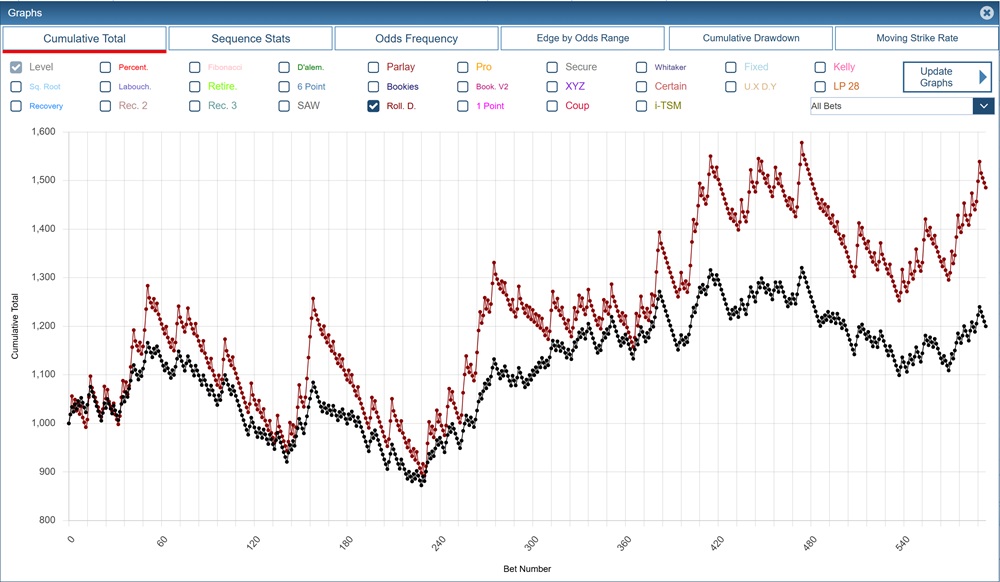
A Rolling Doubles approach would have generated a +48.53-point profit, equivalent to £485.33 based on our £10 starting stake, producing an ROI of 5.37%. This represents a significant improvement over level staking without increasing the underlying selection risk. The image below compares the performance of Rolling Doubles versus level staking throughout the review period, using the BTTS “No” selections that fell within our 2.5 to 3.1 odds range.
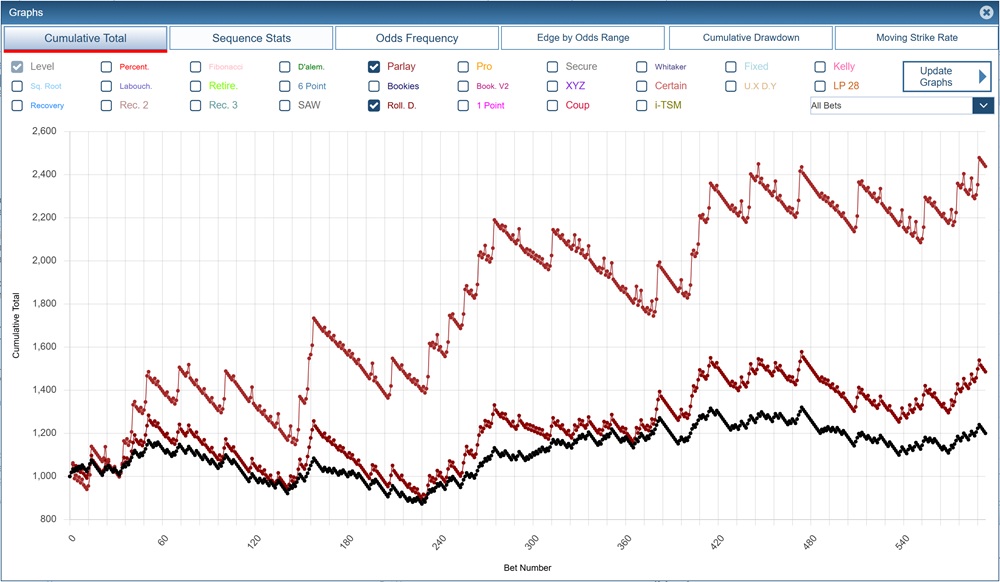
The compounding effect can be taken a step further by using Parlays on the exchanges, essentially a rolling treble. The process involves placing the initial stake on the first selection, then carrying the original stake plus the profit from bet one onto the second selection. The combined stake and profits from bets one and two are then carried forward onto the third selection. Back-testing this approach against the data collected during our trial produces a remarkable +143.84-point profit, equivalent to £1,438.08 based on our £10 starting stake. This represents an impressive 12.01% ROI.
It is important to remember, however, that a Parlay approach is considerably more volatile than level staking. Larger swings in the betting bank should therefore be expected, both upwards and downwards. The image below compares the performance of Parlay staking against level stakes & Rolling Doubles over the review period.
Lulas BTTS Exchange Trial – Final Summary
Lulas BTTS did not produce a profit on the exchanges when used in its standard format, backing every available selection to level stakes. We have no doubt that the service has demonstrated an ability to beat bookmakers, but the combination of several key leagues being unavailable on the exchanges, shorter prices once the markets have formed, and the additional cost of commission meant that the strategy could not replicate its bookmaker performance on Betfair under these conditions.
However, our trial also demonstrated that the service can be adapted successfully for exchange betting. By applying our optimal odds filter and combining qualifying selections into rolling multiples, Lulas BTTS was able to generate positive exchange returns, with the Parlay approach producing particularly impressive results.
The service also has several practical advantages. Selections are delivered early, consistently and in sufficient volume to provide plenty of betting opportunities. Combined with its relatively low subscription cost, this makes Lulas BTTS an interesting proposition for exchange users willing to apply a little more strategy to how the selections are used.
While the standard approach failed our exchange test, our findings suggest that the underlying selections can still provide an edge when combined with the right filters and staking approach.